
The 1971 war reaffirmed the importance of inspirational senior leadership in battle and heralded the emergence of a new fighting class amongst officers and men of India's armed forces.

'What should worry India and which needs to be expressed is Russia's simultaneous proximity to both China and Pakistan from a strategic angle. That hasn't happened ever before,' says Lieutenant General Syed Ata Hasnain (retd).

'Inept handling by the National Security Advisor transformed what should have been a short counter-terrorist operation in Pathankot into an apparent debacle.'
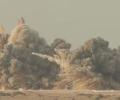
'A conventional war is not in fashion today and not seen as being able to deliver the objective.' 'Perhaps surgical strikes that are deeper, this time not on Pakistan's terrorist facilities, but on Pakistan army facilities.' 'The nation has to be prepared for losses.' 'War is not something that can be pussyfooted around.' 'If we go for limited number of posts in Kashmir, these are very difficult posts to capture and very difficult operations.' 'Be prepared for 200 to 300 killed.'
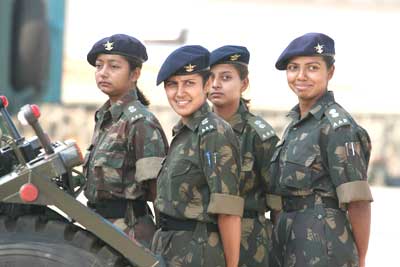
Given how the armed forces struggle to attract talent, they cannot rule out hiring half the population, says Nitin Pai
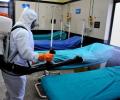
Even though the Health Ministry and Indian Council of Medical Research (ICMR) have been insisting that there is 'no solid evidence' of community transmission so far, the government has started scaling up health infrastructure to deal with any situation.

The entire gamut of China's activities is aimed at keeping India on tenterhooks, cause fatigue to its troops and keeping its security system unstable, so that it cannot play a meaningful role in international geopolitics as an effective partner of the US and Japan, observes Lieutenant General Syed Ata Hasnain (retd).

General Naravane's UAE and Saudi Arabia visits communicate India's long awaited arrival in the domain of integrated foreign policy where the diplomatic and the military domains both complement each other much more substantially, observes Lieutenant General Syed Ata Hasnain (retd).
Indian military sources said no firearms were used in the clashes and that most of the injuries were sustained following stone-pelting and use of rods by the Chinese side.
India's cumbersome arms procurement procedures and a plodding Ministry of Defence bureaucracy have long been blamed for shortfalls in combat capability. Now there is another, more worrying, reason - a growing crisis of funds, magnified by the lack of tri-service coordination.

Will China's new military reforms endanger Xi Jinping's rule?

'Why has the rhetoric gone down on the Indian side, Durrani wondered aloud.' 'I said because almost total normalcy and peace had returned on the ground in Kashmir,' recalls Shekhar Gupta. 'The general gave me that career spook's laser look. And he said: "That situation on the ground can change in no time".' 'This was precisely when the Pakistanis began their first incursions into Kargil.' 'Durrani had been retired for five years.' 'But once the ISI boss, you are always in the know.'

'Pakistan's recent utterances and tendency to use pinpricks to try our patience appear reminiscent of 1965. We are a strong nation, emerging stronger,' says Lieutenant General Syed Ata Hasnain (retd).
Every demand of the armed forces remains essentially anchored to 1964 and its fulfilment or otherwise largely a function of money availability

A war hero looks back at the men and the moments that forged India's greatest military victory.

The broader markets are outperforming the benchmark indices.

The Border Defence Cooperation Agreement with China needs closer scrutiny, says Rup Narayan Das.

'New Delhi showed itself willing -- at least for a period -- to tolerate the risk of conflict and to withstand Beijing's implicit and explicit threats.' 'But it also continued to try to cut some kind of deal with China to reduce tensions.'

'Had they struck on the night of the 1st, there would have been hell to pay and had they been able to sneak further in, we would have had a greater problem,' says Lieutenant General H S Panag (retd), the former Northern Army Commander.

Water levels have started receding in Srinagar and telecommunication has been restored in parts of the city after it faced the worst floods in decades.

On display was India's military might and cultural diversity.

The mortal remains of the nine Siachen bravehearts, who were buried alive on February 3 in an avalanche in the world's highest battlefield, were on Monday brought to New Delhi.

The Sensex ended up 380 points at 27,888 and the Nifty advanced 111 points to end five points shy of 8,400.
'The border standoff, if not properly addressed by both sides, could escalate to a conventional or sub-conventional conflict between India and China,' predicts Srikanth Kondapalli, one of India's leading China experts.

'If you destroy the assets in Pathankot, you degrade the combat potential of India; you degrade the war potential of India.'

'India's military posture has become significantly stronger than China's on the 3,500-kilometre Line of Actual Control.' 'This is enhancing confrontation between the two sides,' points out Ajai Shukla.

Over 1,42,000 people have been rescued from the flood-ravaged parts of Jammu and Kashmir so far, as the relief operations launched by the Armed forces entered the 12th day on Saturday.
'Had this been handled in a correct way, the only lives that would have been lost, presumably, were the lives of the terrorists and that would have been welcome.' The information we had was pure gold. You seldom get information of this kind several hours in advance, exactly where they are going to strike. But we still couldn't act on this intelligence.'

'Belonging to a Muslim family, I obviously had my own set of issues to deal with but I don't remember my father saying 'no' to anything.'
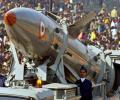
It is time the new government, unencumbered with the burden of past, initiates a wide ranging review and open debate on the security issues to rectify our short term and long term shortcomings. It has taken some wise steps but has to go beyond this to identify the structural weakness and create systems, says Colonel (retd) Anil Athale.

'A stronger response on the border, some action needs to be taken against Pakistan from where the terrorists come, and finally what needs to be done is to calm Kashmir down,' Lieutenant General D S Hooda (retd) -- the Northern Army Commander under whose watch the Indian Army conducted the 2016 surgical strikes -- tells Rediff.com in an exclusive interview.
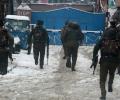
'We need to be in a perpetual state of aggression, and able to swiftly change the goal posts to keep Pakistan in a state of imbalance,' argues Sanjeev Nayyar.

'Perhaps the biggest indication was its striking decision in November to delink LeT from its aid certification process.' 'The administration decided that the US, in order to send military aid to Pakistan, would not need to certify that Pakistan is cracking down on LeT.' 'Perhaps the administration was trying to offer a carrot -- in effect, we're backing off on LeT, but in return we expect you (Pakistan) to go after the Haqqanis.' 'Either way, the optics were dreadful for the US given that Hafiz Saeed was released from house arrest a few days after the US move.' 'The US reacted angrily, but eventually it moved on, and refocused on its core concern: The Afghan-focused terror groups.'

'We owe our existence to the men in uniform, and we owe it to them to cleanse the armed forces by driving away every bit of corruption that eats into it,' argues Sudhir Bisht.

As India celebrates its 67th Republic Day, Rediff.com takes a look at some brave men who stood their ground to protect their country from those who sought to bleed it.

Lieutenant General J F R Jacob, Chief of Staff, Eastern Army Command during the 1971 war, revealed how, armed with only a draft surrender document and an aide, he made the Pakistani army led by Lieutenant General A A K Niazi surrender.
Lieutenant General J F R Jacob, Chief of Staff, Eastern Army Command during the 1971 war, revealed how, armed with only a draft surrender document and an aide, he made the Pakistani army led by Lieutenant General A A K Niazi surrender.
Lieutenant General J F R Jacob, Chief of Staff, Eastern Army Command during the 1971 war, revealed how, armed with only a draft surrender document and an aide, he made the Pakistani army led by Lieutenant General A A K Niazi surrender.
Lieutenant General J F R Jacob, Chief of Staff, Eastern Army Command during the 1971 war, revealed how, armed with only a draft surrender document and an aide, he made the Pakistani army led by Lieutenant General A A K Niazi surrender.
Lieutenant General J F R Jacob, Chief of Staff, Eastern Army Command during the 1971 war, reveals how, armed with only a draft surrender document and an aide, he made the Pakistani army led by Lieutenant General A A K Niazi surrender.
